Drovqelianix
Drift Library
Drift Library
Couldn't load pickup availability
1. Problem Statement
After working with several page blocks, learners often need more examples to compare, revise, and rebuild. A single exercise can teach one idea, but real practice usually requires variation. Different layouts use different spacing, content order, image placement, and visual rhythm. Without organized reference materials, learners may repeat the same structure and miss other useful approaches. Drift Library helps learners study HTML/CSS through a broader collection of page patterns and guided refinements.
2. Solution
This course provides a structured library of HTML/CSS materials centered on page sections and reusable styling ideas. Learners explore several examples, then adjust them through focused tasks. Each module shows how small code choices affect layout, spacing, readability, and visual balance. The course encourages learners to compare different versions of the same section instead of copying one fixed layout. This gives learners a deeper understanding of how HTML structure and CSS styling work together.
3. What’s Inside
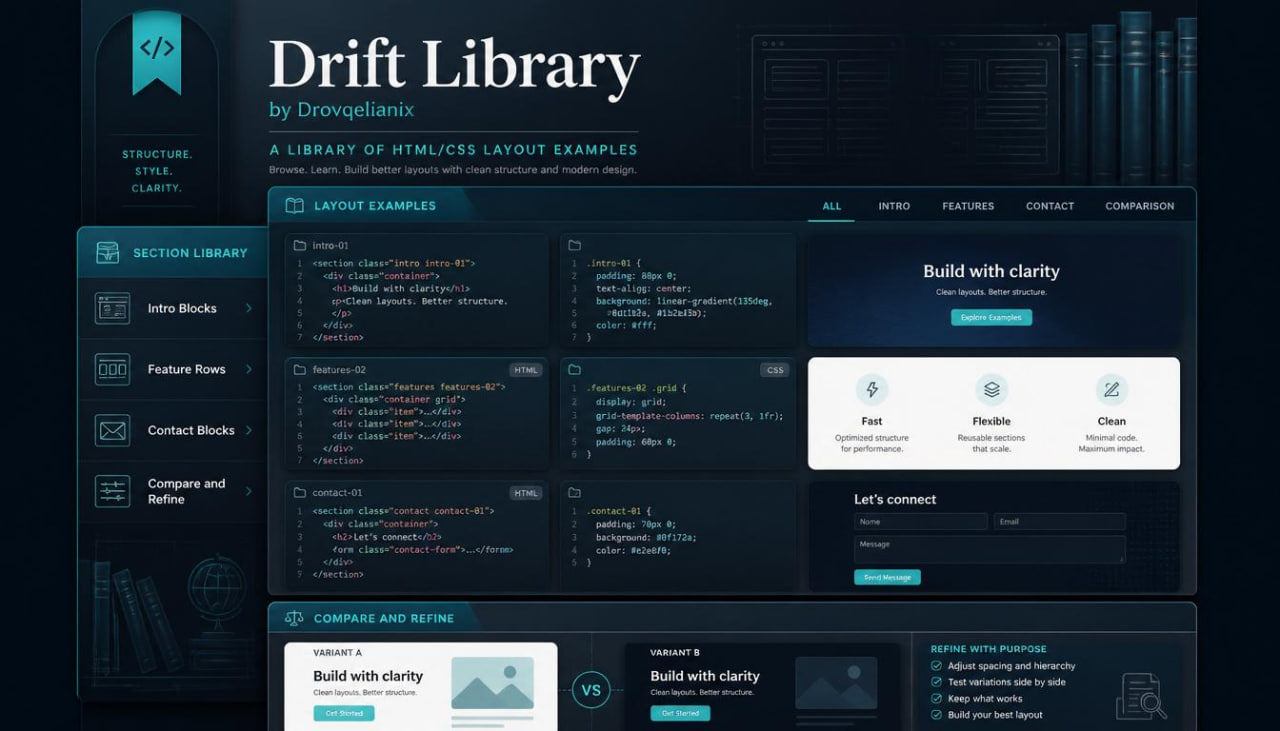
Drift Library includes a collection of HTML/CSS section materials for practice and study. The course begins with layout references for intro sections, content blocks, course cards, feature rows, quote areas, contact blocks, and footer sections. Each example includes notes about structure, class naming, spacing, typography, and styling choices.
The HTML materials focus on semantic section building, heading order, content grouping, link placement, and image organization. The CSS materials cover reusable spacing values, text styling, background layers, borders, flexible rows, grid-based layouts, and responsive adjustments for different screen widths. Learners also study how to keep styles organized across multiple sections without creating scattered code.
Drift Library includes guided rebuild tasks where learners recreate a section from a reference, then make small changes to content order, spacing, colors, and layout direction. There are also comparison tasks that place two versions of a section side by side, helping learners notice how visual decisions change the reading flow.
The course includes a style reference sheet for naming patterns, spacing groups, font sizes, card structures, and button variations. Learners also receive review prompts for checking repeated code, uneven spacing, unclear hierarchy, and layout issues. A final practice task asks learners to combine several selected sections into one static page draft with a consistent visual system.
4. Who Is This For?
Drift Library is intended for learners who already know basic HTML/CSS and want more structured practice with real page sections. It fits learners who like studying examples, comparing layouts, and revising code with intention. It is also useful for anyone who wants a larger set of materials for repeated coding practice.
5. What You’ll Learn
- How to study HTML/CSS through organized section examples.
- How to compare different layout variations.
- How to build intro sections, cards, content rows, and footer areas.
- How to use reusable spacing, typography, and color rules.
- How to revise existing HTML/CSS without making the code messy.
- How to combine several sections into one static page draft.
- How to review layout consistency across multiple page blocks.
6. 30-Day Refund Terms
Drift Library includes a 30-day refund option under the store’s written policy. The terms should explain the request window and purchase conditions in plain wording, without claims about personal outcomes.
Self-paced learning overview
- 🗂️ Digital file available after purchase
- 📚 Long-term availability
- 🔐 Secure checkout
- 🛠️ Content updated in 2026
How are the courses arranged?
How are the courses arranged?
Each course is built around modules, written materials, practical tasks, and examples for HTML/CSS study.
Do I need prior coding knowledge?
Do I need prior coding knowledge?
No prior coding background is required for the first plan. Higher plans move into broader layout and styling topics.
What happens after choosing a plan?
What happens after choosing a plan?
You receive the materials connected to that plan and can study them at your own pace.
Share